

Request an Appointment or call us
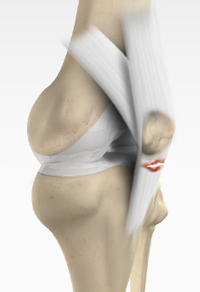
What is Patellar Tendon Rupture?
The patellar tendon works together with the quadriceps muscle and the quadriceps tendon to allow your knee to straighten out. Patella tendon rupture is the rupture of the tendon that connects the patella (kneecap) to the top portion of the tibia (shinbone).
What are the Causes of Patellar Tendon Rupture?
A patellar tendon tear most commonly occurs in middle-aged people who participate in sports that involve jumping and running. It can rupture due to a fall, direct blow to the knee or landing on your foot awkwardly from a jump. The other causes may include patellar tendonitis (inflammation of patellar tendon), diseases such as rheumatoid arthritis, diabetes mellitus, infection, and chronic renal failure. The use of medications such as steroids can cause increased muscle and tendon weakness.
What are the Symptoms of Patellar Tendon Rupture?
When the patellar tendon tears, the patella may lose its anchoring support on the tibia, as a result, when the quadriceps muscle contracts, the patella may move up into the thigh. You are unable to straighten your knee and upon standing, the knee buckles upon itself. In addition to this, you may have pain, swelling, tenderness, a tearing or popping sensation, bruising and cramping.
A patellar tendon tear can be a partial or complete tear.
- In a partial tear, some of the fibers in the tendon are torn, but the soft tissue is not damaged.
- In a complete tear, the soft tissues are disrupted into two pieces.
How is Patellar Tendon Rupture Diagnosed?
To identify a patellar tendon tear, your doctor will review your medical history and perform a physical examination of your knee. Some imaging tests, such as an X-ray or magnetic resonance imaging (MRI) scan may be ordered to confirm the diagnosis.
What is the Treatment for Patellar Tendon Rupture?
Patellar tendon ruptures can be treated by non-surgical and surgical methods.
Non-surgical Treatment of Patellar Tendon Rupture
Non-surgical treatment involves the use of braces or splints to immobilize the knee. Physical therapy may be recommended to restore the strength and increase the range of motion of the knee.
Surgical Treatment of Patellar Tendon Rupture
The goal of the surgery is to reattach the torn tendon to the kneecap and restore the normal function in the affected leg. Surgery is performed under regional or general anesthesia on an outpatient basis. An incision is made on the front of the knee to expose the ruptured tendon. Holes are made in the patella. Strong sutures are tied to the tendon and threaded through these holes. These sutures are tied in place to pull the torn edge of the tendon back to its normal position on the kneecap.
Severe damage can make the patellar tendon very short, and in such cases, reattachment will be difficult. Your surgeon may attach a tissue taken from a donor (allograft) to lengthen the tendon.
What Does Postoperative Care for Patellar Tendon Rupture Involve?
Following surgery, a brace may be necessary to protect the healing tendon. Complete healing of the tendon will take about 6 months.
What are the Risks and Complications of Surgical Treatment for Patellar Tendon Rupture?
As with all surgeries, surgery for patellar tendon rupture may be associated with certain risks and complications such as weakness and loss of motion. In some cases, the tendon that is re-attached may detach from the kneecap or tear. Other complications such as infection and blood clot may be observed.
For more information about our services Hip, Knee or to schedule an appointment, call us at or click here to request an appointment online. We’ll respond to you as soon as possible.