
Request an Appointment or call us
Introduction
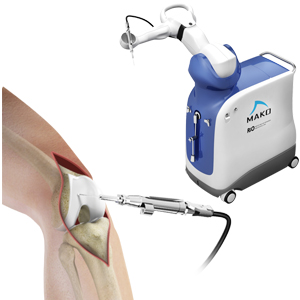
Dr. Reddy employs many techniques for knee replacement to enhance recovery and create a more natural feeling total knee replacement. He performs knee replacement with the Subvastus Quadriceps-Sparing Approach for knee replacement which does not violate your quadricep mechanism, unlike more traditional approaches that cut the vastus medialis muscle tendon from the extensor mechanism to gain access to the knee. Additionally, Dr. Reddy uses Mako SmartRoboticsTM CT based navigation and the Mako Robotic-assisted arm to prepare the bone and position the implants to match your native anatomy, and deliver additional precision to your knee replacement. To learn more about knee arthritis and knee replacement, please read more below.
What is Knee Arthritis?
The joint surface of the knee is covered by smooth articular surface that allows pain-free movement in the joint. Arthritis is a general term that covers numerous conditions where the joint surface or cartilage wears out. When the articular cartilage wears out, the bone ends rub on one another causing pain and stiffness. The most common type of knee arthritis is osteoarthritis and it occurs with aging and use.
What are the Causes of Knee Arthritis?
There are numerous conditions that can cause arthritis, but often the exact cause is never known. In general, but not always, it affects people as they get older. Other causes include:
- Trauma (fracture)
- Increased stress such as overuse or overweight
- Inflammatory disease (rheumatoid arthritis)
What are the Symptoms of Knee Arthritis?
Knee arthritis causes pain and decreased mobility in the knee joint. The cartilage lining is thinner than normal or completely absent. Sometimes extra bone is formed by your knee as a reaction to the thinning cartilage. This extra bone can contribute to pain and stiffness. The knee capsule can also become inflamed. The combination of these factors make the arthritic knee stiff and limit activities due to pain or fatigue.
How is Knee Arthritis Diagnosed?
We diagnose knee arthritis by obtaining a medical history, performing a physical examination and obtaining X-rays of your knee. Sometimes we even obtain an MRI.
What is the Treatment for Knee Arthritis
There are several treatments and lifestyle modifications that can help you ease your pain and symptoms. The objective of treatment is to reduce pain, improve joint movement and prevent further damage to the joint.
Treatment often includes the following:
- Lifestyle Modifications:
- A moderate exercise program to strengthen you knee, hip and core muscles.
- Eating a healthy and well balanced diet.
- Weight loss - even minor weight loss can decrease the stress on your arthritic knee and improve your pain.
- Heat or cold therapy.
- Physical Therapy:
- Formal physical therapy to help you strengthen your knees, hips and core can help alleviate the stress your knee is feeling and improve your joint function.
- Medications:
- Tylenol and anti-inflammatory medication like NSAIDs (Advil, Aleve, Mobic, Celebrex, etc) are helpful to decrease inflammation and pain caused by the arthritis.
- Injections:
- Cortisone injections are a simple, quick and effective office procedure to decrease pain and swelling in an inflamed joint caused by arthritis.
- Gel or Hyaluronic Acid injections can provide additional lubrication and anti-inflammatory effects to decrease pain.
- Platelet rich plasma (PRP) injections may be an option in select individuals with mild arthritis.
- Surgery:
- Surgery is usually considered if non-surgical treatment fails to provide relief and knee pain is severe enough to affect your ability to carry out normal activities. Surgery is offered in the form of total knee replacement or partial knee replacement, for select individuals.
What is Total and Partial Knee Replacement?
Knee replacement, also called Knee Arthroplasty, is a surgical procedure in which the worn out surfaces of the knee joint are removed and replaced with an artificial prosthesis. There are three compartments in the knee that are often diseased: the medial compartment, the lateral compartment and the patella-femoral compartment. Most people who have knee arthritis, have arthritis that involves two of the three compartments and these people are a candidate for total knee replacement. Some people have arthritis in only one of these compartments and they may be a candidate for partial knee replacement where only 1 of the 3 possible compartments is replaced.
What are the Indications for Knee Replacement?
Total Knee replacement surgery is commonly indicated for severe osteoarthritis of the knee. You may have severe pain that limits your daily activities (such as walking, getting up from a chair, or climbing stairs). You may have pain that occurs at rest or at night. The knee pain and inflammation you have is not relieved with rest or medications. Other modalities like injections and physical therapy are often not helping as well. If you have pain in your knee from arthritis and prior non-surgical treatments are no longer working, you may be a candidate for knee replacement.
What is Subvastus Muscle-Sparing Knee Replacement?
Subvastus Muscle-Sparing Total Knee Replacement is a minimally invasive surgical technique for total knee arthroplasty that preserves the quadricep muscle, specifically the vastus medialis muscle and its neurovascular integrity. Traditional approaches to total knee replacement often involve cutting the tendinous portion of the vastus medialis muscle to gain access to the knee joint to perform the surgery. When Dr. Reddy performs the subvastus total knee replacement, he does not cut your quadricep muscle. Instead, he mobilizes the muscle and goes to the side and underneath the vastus medialis muscle without cutting the quadricep muscle. This allows for decreased soft tissue trauma and an enhanced early recovery by preserving your quad tendon/muscle. This approach can be used for total and partial knee replacement.
What is the Procedure for Subvastus Quadriceps-Sparing Total Knee Replacement?
The Subvastus Quadriceps-Sparing Total Knee Replacement Involves the following steps:
- Incision: A standard midline incision centered over your knee is performed.
- Accessing the Knee Joint: The vastus medialis muscle is gently mobilized by going to the side and underneath to expose the joint capsule instead of cutting directly into the quadricep tendon.
- Bone Preparation: the worn out knee surfaces are prepared with a saw for your new implants.
- Prosthesis Placement: The new implants made of metal and plastic to recreate your new smooth knee joint are put in place.
- Closure: The knee joint and the incision is closed in a layered fashion using sutures that are completely buried underneath the skin. A sterile dressing is then applied.
What are the Advantages of the Subvastus Quadriceps-Sparing Total Knee Replacement?
- Enhanced Post-operative Recovery
- Preservation of Quadriceps Strength
- Reduced Rehabilitation time
What is Robotic-Assisted Knee Replacement using Mako SmartRoboticsTM?
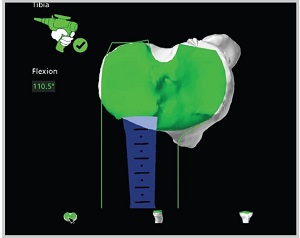
Robotic-assisted knee replacement surgery is an alternative technique to knee replacement which utilized 3-dimensional planning and robotic arm-technology to plan and execute total and partial knee replacement with additional precision compared to traditional knee replacement surgery. A pre-operative CT scan is obtained which is used to create a 3D model of your anatomy and arthritis. This 3-D model is then used to pre-plan your knee replacement to match your native joint line and adjust the implants with extreme precision to balance your knee. During surgery, the Mako robotic arm is used to prepare the bone with Mako’s AccuStopTM Technology to ensure enhanced precision and decrease soft tissue injury. The implants are then placed and the incision is closed in standard fashion. Mako SmartRobotics facilitates enhanced precision, improved recovery and a more natural feeling joint replacement.
For more information about our services Hip, Knee or to schedule an appointment, call us at or click here to request an appointment online. We’ll respond to you as soon as possible.